6 minute read · Ultimo Research Desk · Reviewed 5 Sept 2026
MT5 Order Types: What Each One Promises, and What It Does Not
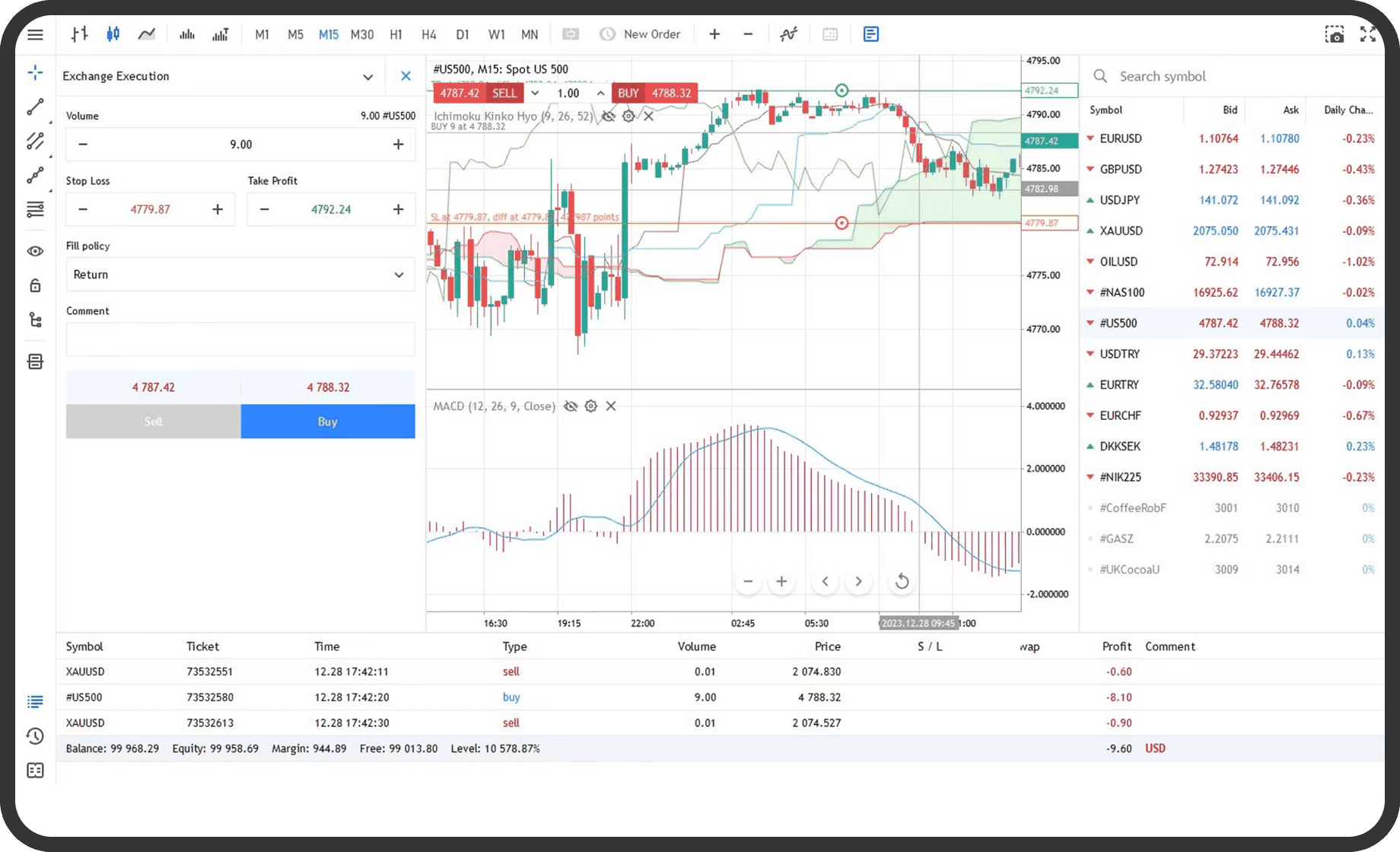
Every order type is a promise with a condition attached, and most trading losses that feel unfair come from believing the promise without reading the condition. This is what each one in MetaTrader 5 actually guarantees.
Market order
Buy or sell now, at the next available price.
Guarantees that you are in. Does not guarantee at what price.
In a quiet market the difference is nothing. Around a scheduled release or at the Sunday reopen it can be substantial — that gap between the price you clicked and the price you got is slippage, and it runs in both directions even though only one is memorable.
The four pending orders
These are one idea with two variables: are you buying or selling, and is your level above or below the current price. Learning them as four separate things is why they feel confusing.
Buy limit — buy below the current price. You expect a dip and want in cheaper. Sell limit — sell above it. You expect a rally and want to short higher. Buy stop — buy above it. You expect a breakout upwards and want in once it happens. Sell stop — sell below it. The mirror image.
The mental model: a limit waits for a better price, a stop waits for confirmation.
That difference decides how they fill. A limit order guarantees your price or better and does not guarantee a fill — the market can turn one tick away and leave without you. A stop order becomes a market order the moment it triggers, so it guarantees a fill and not the price.
Buy stop limit and sell stop limit are the two MT5 adds beyond MT4: a stop that, when triggered, places a limit order rather than a market one. It is a way of saying "only chase this breakout up to here, and no further".
Stop loss and take profit
Both attach to a position rather than standing alone, and both live on the broker's server — they work whether or not your platform is open.
Take profit is a limit order to close: your target or better.
Stop loss is a stop order to close, and it is worth being precise about it. It instructs a close when the price reaches your level. It does not create a buyer at your level. If the price gaps — jumping from one level to another with no trading in between, which happens over weekends and on unscheduled news — it fills at the first price that existed afterwards, which can be considerably worse than the one you set.
This is the single most important sentence on this page: a stop loss caps your intended loss, not your possible one. What caps the possible one is position size.
Trailing stop: the one that stops when you do
A trailing stop follows the price at a fixed distance as a trade moves in your favour and stays put when it moves against.
It also behaves differently from everything else here, and most guides do not mention it. In MetaTrader, the trailing stop runs in your terminal, not on the broker's server. The platform's own documentation states it plainly: it does not work if the terminal is off.
Practically, that means:
- Close MT5, and the trailing stops. Whatever stop level it had already moved to remains on the server — that part is a real stop loss and stays — but it will not trail any further.
- Lose your connection and the same applies.
- Leave your laptop asleep overnight expecting a trail to protect an open position, and it will not.
This is not a fault and it is not hidden; it is simply the sort of detail that is only ever learned the expensive way. If a trailing stop is central to your method, it belongs in an expert advisor on a machine that stays on, not in a terminal you close at the end of the day.
Fill policy
MT5 asks how an order should behave when the full size cannot be filled at once. The choice appears on the order ticket and the available options depend on the instrument.
Fill or Kill — all of it at the price, or none of it. Immediate or Cancel — fill what is available, cancel the rest. Return — fill what is available, keep the remainder working.
On retail-sized positions in liquid instruments this rarely comes up. It comes up in thin conditions and at large size, which are exactly the moments when a partly filled position you did not expect is a problem.
Expiry
A pending order can be Good till cancelled, which is the default and means what it says; Day, cancelled at the end of the trading day; or Specified, cancelled at a date and time you set.
The habit worth having is to put an expiry on any order whose reasoning has a shelf life. An order placed on Tuesday's analysis, still sitting there on Friday, is not a plan — it is a trap you set for yourself and forgot about.
What no order type protects you from
Gaps. Covered above, and the reason a guaranteed stop — which the broker honours at your level and charges a premium for — is the only order that closes this hole.
Widening spreads. Your stop triggers on the bid or the ask depending on direction. In the seconds around a release, a spread that widens by several pips can reach a stop the mid-price never approached. This is normal behaviour rather than a fault, and it is a reason not to place stops within ordinary noise of the price.
Yourself. The most common failure is not an order behaving unexpectedly. It is an order being moved — a stop widened because the price is approaching it — which converts a defined loss into an undefined one. If you are going to move a stop, decide beforehand that you will never move it further away.
A practical setup
- Decide where the idea is wrong. That is your stop level, from the chart rather than from what you can afford.
- Size the position from that stop and your risk budget, not the other way round. The position size calculator does this in the right order.
- Place entry, stop and target together. Setting the target later, in the moment, is how plans get rewritten by positions that are currently working.
- Put an expiry on the pending order if the reasoning has one.
- Check what the trade is worth in money before you place it, with the profit and loss calculator — including the losing side.
Practise all of it on a free demo account until placing and modifying orders is mechanical. Doing it for the first time in a moving market with real money is the most avoidable difficulty in trading.
Written by the Ultimo Research Desk and checked against our own contract specifications and client agreement before publication; reviewed again when those change. Educational only — nothing here is a recommendation to trade. Spotted an error? Tell us.