5 minute read · Ultimo Research Desk · Reviewed 5 Sept 2026
What Is a Margin Call? (And How Never to Get One)
Few phrases make a trader's stomach drop like "margin call." Yet a margin call is not bad luck — it is arithmetic, visible hours or days in advance to anyone watching the right numbers. This guide explains exactly how margin works and the habits that make margin calls a thing that happens to other people.
The Four Numbers That Run Your Account
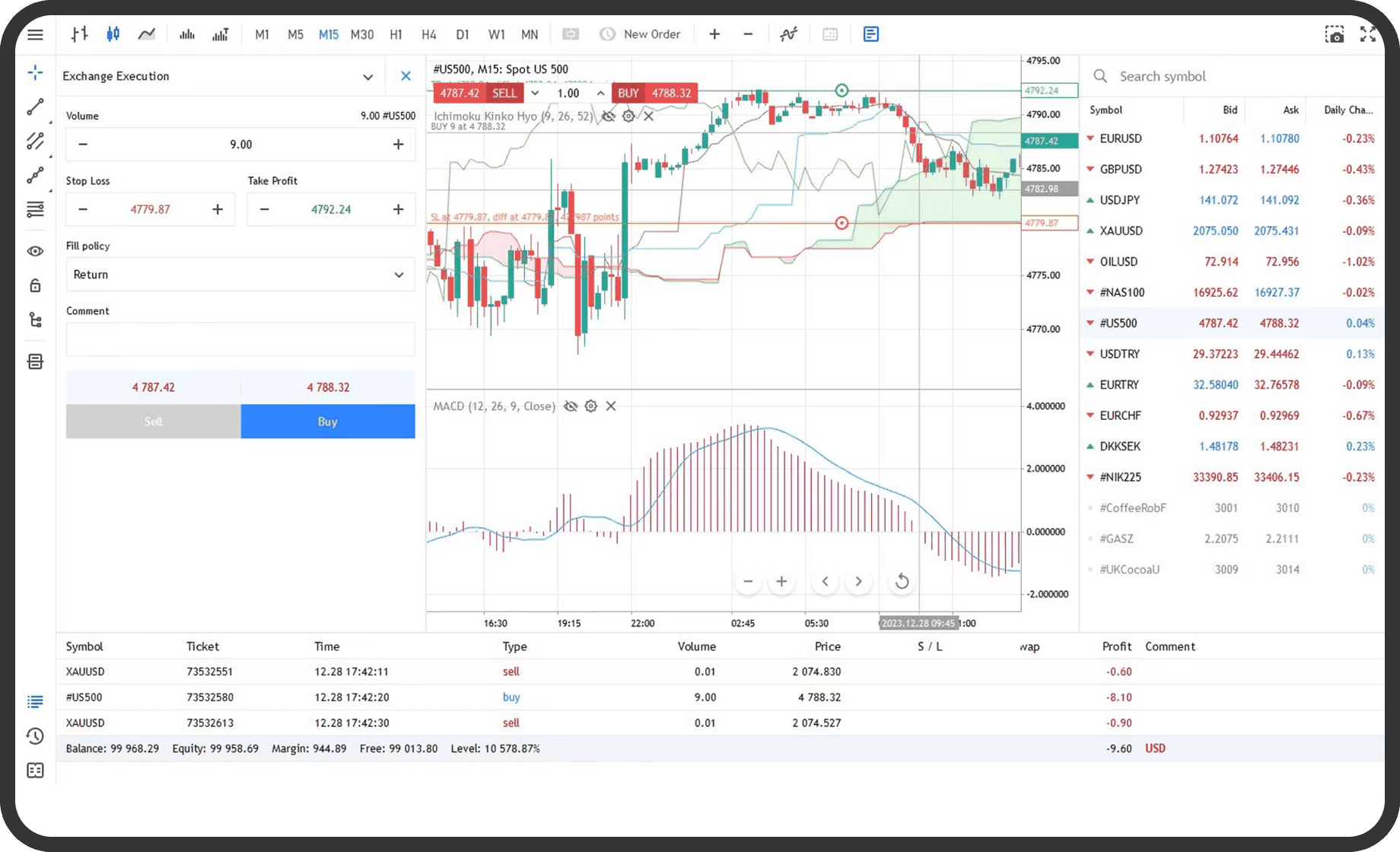
Open any MetaTrader 5 account and you'll see four numbers at the bottom of the terminal:
- Balance — your deposited money plus closed-trade results. It only changes when a trade closes.
- Equity — balance plus the floating profit/loss of your open positions. This is what your account is really worth right now.
- Margin — the deposit locked as collateral for your open positions. With 100:1 leverage, a 1-lot EUR/USD position (€100,000) locks about €1,000.
- Free margin — equity minus margin: the fuel you have left for new positions and for absorbing losses.
Margin Level: The Number That Matters
Margin level = (equity ÷ margin) × 100. It is your account's health meter:
- Above 1000% — comfortable; positions are small relative to your account.
- Around 200–500% — working hard; a bad day can get uncomfortable.
- At 100% — your equity only just covers your collateral. Most brokers set the margin call here: you can't open new positions, and you're being warned.
- At the stop-out level (often 50%) — the platform begins force-closing your positions, starting with the biggest loser, until margin level recovers.
A margin call, then, is simply your margin level decaying — something you can watch happen in real time.
How Traders Actually Get Margin Called
It's almost never one dramatic market move. The pattern is depressingly consistent:
- Oversizing — positions far too large for the account, so ordinary volatility consumes free margin.
- No stop-losses — losing positions left open "until they come back," bleeding equity.
- Adding to losers — averaging down multiplies both margin used and the loss rate.
- Holding blind through news — a central bank surprise can move a pair more in minutes than in a normal week.
Notice that all four are choices, not accidents.
The Prevention Playbook
- Risk 1–2% per trade, always. Position size follows from your stop distance — see our trading plan guide. Sized this way, a margin call is mathematically remote.
- Every position has a stop-loss. A stop caps the equity drain before it ever threatens your margin level.
- Watch margin level, not hope. If it trends below ~500%, you are oversized for conditions — reduce.
- Keep cash in reserve. Using a fraction of available leverage means volatility spikes are absorbed, not fatal.
- Know the calendar. Flatten or reduce before major releases unless news is your strategy — one of the ten rules worth living by.
If You're Close to the Edge Right Now
Close the worst position yourself — before the platform chooses for you at a worse price. Then cut overall size, and only rebuild when margin level is comfortably high. Never "rescue" a drowning account by adding a bigger position in the other direction; that's how one margin call becomes two.
A Margin Call, Step by Step
Numbers make this concrete. Suppose you deposit $2,000 and open one standard lot of EUR/USD at 1.0850 with 100:1 leverage.
- Position value: $108,500
- Margin required: $1,085
- Free margin: $2,000 − $1,085 = $915
- Margin level: equity ÷ used margin = 2,000 ÷ 1,085 = 184%
The trade goes against you. Every pip costs about $10.
Down 40 pips. Equity is $1,600. Margin level is 147%. Nothing has happened yet, and this is the point at which most people start watching the screen instead of their plan.
Down 65 pips. Equity is $1,350. Margin level is 124%. You are near the warning threshold at many brokers.
Down 90 pips. Equity is $1,100. Margin level is 101%. A margin call warning appears. You can still act: close part of the position, or accept the loss and close it.
Down 110 pips. Equity is $900. Margin level is 83%. At a 50% stop-out level you are not there yet — but you are now one news release away.
Notice what the sequence shows. A 110-pip move is an ordinary day in EUR/USD. It did not take a crash to get here; it took one standard lot on a $2,000 account. The size was the mistake, not the market.
Run the same move on a mini lot — one tenth the size — and the same 110 pips costs $110, leaving equity at $1,890 and a margin level above 1,700%. Same trade, same analysis, same outcome in the market; an entirely different experience.
Why Adding Money Is Usually the Wrong Answer
The instinct when a margin call arrives is to deposit more. It works, mechanically: fresh funds lift equity, the margin level recovers, the position survives.
It is also how small losses become large ones. You have not changed the trade or the reason it is losing; you have made the losing position a larger share of your total capital. If the move continues, the next margin call arrives against a bigger deposit.
The uncomfortable question is the useful one: if I had no position right now, would I open this one at this price? If the answer is no, adding money is not conviction — it is an unwillingness to take a loss you have already taken.
Closing part of the position does the same arithmetic without that risk. Halving your size halves the required margin and halves what each further pip costs you, and it leaves you in the trade if you still believe in it.
The Mindset Shift
Amateurs treat margin as buying power; professionals treat it as survival distance — how much adversity the account can absorb before losing control. Leverage doesn't destroy accounts; sizing does.
Our margin calculator shows both numbers side by side — the margin a position ties up and the position value that actually moves with the market — because the distance between them is the whole subject of this article.
Practice reading balance, equity, margin and margin level on a free demo account until the numbers feel like instruments on a dashboard. Then trade live with Ultimo — transparent pricing, MetaTrader 5's full risk toolkit, and a regulated broker (FSC Mauritius, GB24203027) behind your account.
Written by the Ultimo Research Desk and checked against our own contract specifications and client agreement before publication; reviewed again when those change. Educational only — nothing here is a recommendation to trade. Spotted an error? Tell us.
Ready to see how forex trades at Ultimo?
Forex trading