12 minute read · Ultimo Research Desk · Reviewed 5 Sept 2026
What is CFD Trading? Ownership, Leverage, Costs and Risk
A contract for difference is an agreement between you and a broker to exchange the difference in an asset's price between the moment the contract opens and the moment it closes. If the price moves your way, the broker pays you the difference. If it moves against you, you pay it.
That is the whole product. Everything else — the leverage, the ability to go short, the overnight financing — follows from the fact that no asset changes hands.
What you own: nothing
This is the part that gets glossed over, and it is the single most important thing to understand.
Buy a share and you own a piece of a company. You appear on the register, you can vote, you receive dividends, and you can hold it for thirty years. Buy a share CFD and you own a contract about that share's price. There is no register, no vote, no certificate. Buy a gold CFD and there is no metal anywhere.
Two things follow.
The first is that a CFD can be leveraged, because you are not paying for an asset — you are posting collateral against a price movement. The second is that you can sell first and buy back later as easily as the other way round, because there is nothing to borrow. Neither is possible with the underlying asset in the same way, and both are the reason CFDs exist.
It also means a CFD is a contract with a specific counterparty. Its value depends on that firm being able to pay, which is why the regulation of the firm — and where its client money sits — matters more here than it would for an asset held in your own name.
How a CFD trade works
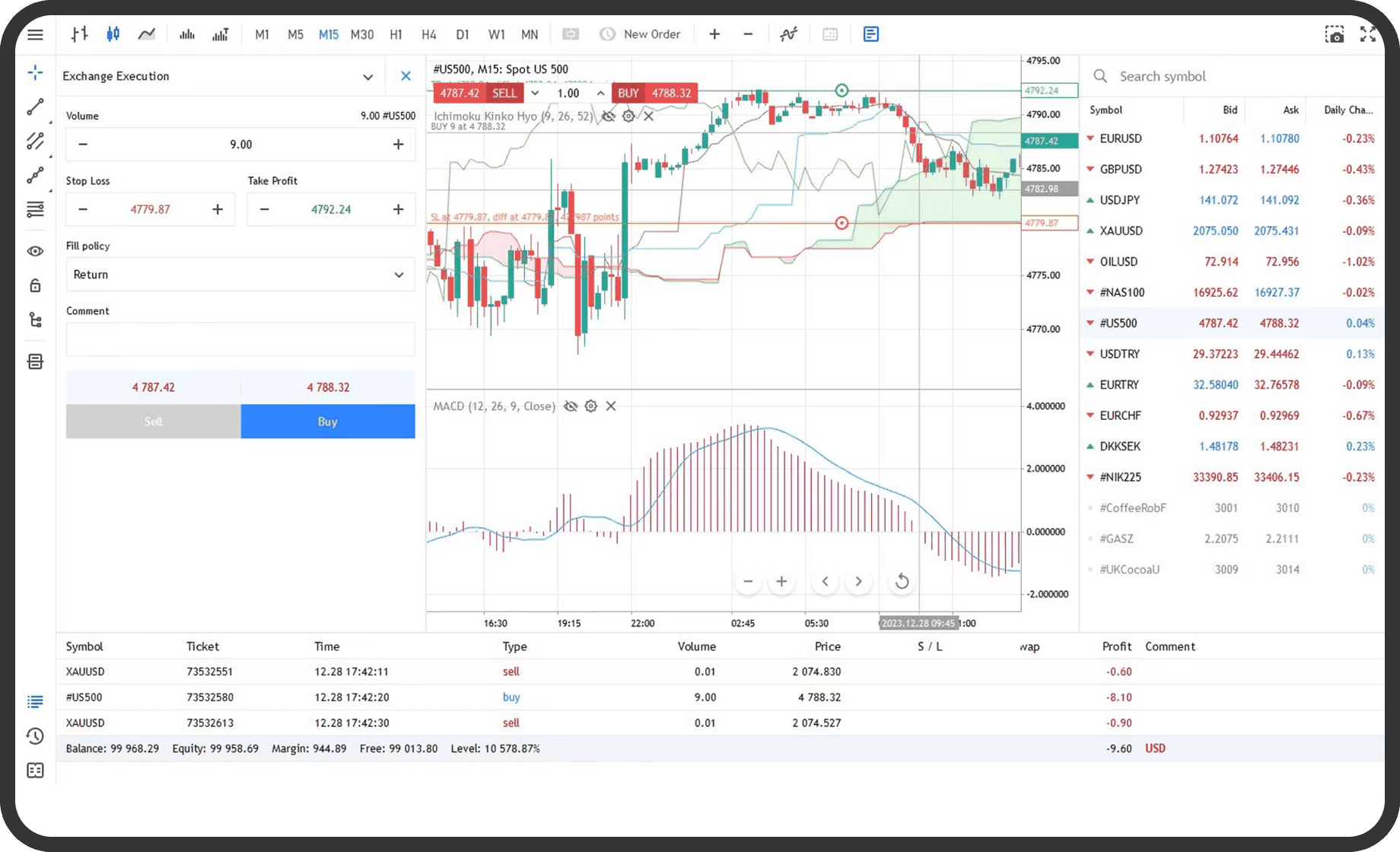
- Choose an instrument and a size. Size is in lots, and a lot means different quantities on different instruments: 100,000 units of the base currency in forex, 100 troy ounces in gold. What a one-tick move is worth follows from that, not from the price.
- Go long or short. Long if you expect the price to rise, short if you expect it to fall. Short is not an advanced technique here; it is structurally identical to long.
- Margin is set aside. A fraction of the position value is reserved from your balance. It is not a fee and it comes back when you close.
- The position runs. Its value moves with the price, and financing is charged or credited each night it stays open.
- You close. The difference between the opening and closing price, multiplied by your size, is settled in cash.
Leverage: what it does and what it does not
With 100:1 leverage, $1,000 of margin supports a $100,000 position.
The half that gets advertised is that a small deposit goes a long way. The half that decides outcomes is that the entire $100,000 moves with the market. A 1% adverse move is $1,000 — the whole deposit — and 1% is an ordinary day in most markets.
Leverage does not increase risk by itself. It removes the capital barrier that would otherwise have stopped you taking a position that size, and the position was always the risk. Two people holding one lot of EUR/USD have identical exposure whether one used 30:1 and the other 100:1; only the money tied up differs. What makes a position dangerous is its size relative to the account, which is why position sizing is the calculation to do first and the one most beginners do last.
When losses eat far enough into your equity, the platform issues a margin call — a warning — and then a stop-out, closing positions automatically at whatever price exists at that moment. A stop-out is not a stop loss you chose. Our guide to margin calls covers the sequence in detail, and the margin calculator shows the margin and the position value side by side, because the gap between them is the subject.
A worked example
You think the S&P 500 will rise. The index CFD is quoted 5,240.0 / 5,240.6, and one lot is $1 per index point.
You buy 2 lots at the ask, 5,240.6.
- Position value: 2 × 5,240.6 = $10,481. At 100:1, the margin set aside is about $105.
- The spread is 0.6 points on 2 lots, so you start about $1.20 down.
- The index rises to 5,268.0 and you close at the bid. The move in your favour is 27.4 points: 27.4 × 2 = +$54.80, less the spread.
- Had it fallen 27.4 points instead, the loss would have been −$54.80 against margin of $105.
That last line is the point. A move of half a percent produced a gain or loss of more than half the margin. The $105 is what the position ties up; the $10,481 is what it is.
You can run either side of this on the profit and loss calculator. Putting the losing exit in first is the habit worth building.
What a CFD actually costs
Three charges, and any comparison that mentions one of them is comparing part of a price.
Spread. The gap between the buy and sell price, paid on the way in and again on the way out. It is not constant: it widens when fewer institutions are quoting, which is why the same trade costs more at 03:00 UTC than at 14:00, and widens sharply around scheduled releases. Our market hours page shows which sessions are dealing.
Commission. A charge per lot on account types offering tighter raw spreads in exchange. "Zero commission" does not mean free — it means the cost lives in the spread instead. Which is cheaper depends entirely on how much you trade.
Overnight financing, or swap. A daily debit or credit for holding a leveraged position past the rollover. On a trade held for an afternoon it is nothing. On one held for two months it can exceed everything else combined, and it is the cost that surprises people most often. One day a week — usually Wednesday in forex — three days' worth is charged at once to cover the weekend.
Two more apply to specific instruments. Dividend adjustments: when a share or index goes ex-dividend the price drops by roughly the dividend, so an adjustment is credited to long positions and debited from short ones — the dividend is neither a windfall nor a penalty. And rollover on futures-based CFDs, where many commodities and some indices have expiry dates and a position held through one is rolled into the next contract with a price adjustment.
CFDs compared with what they are not
CFDs and shares
| Share | Share CFD | |
|---|---|---|
| Ownership | Yes — register, votes, certificate | No — a contract about the price |
| Dividends | Paid to you | An adjustment applied to the position |
| Leverage | Generally none | Yes |
| Going short | Difficult, requires borrowing | Same as going long |
| Holding period | Indefinite, no carrying cost | Financed nightly |
| Suits | Building a position over years | Views measured in days or weeks |
In summary, they answer different questions. A CFD is a poor instrument for a decade-long investment, because you would pay financing every night of it. A share is a poor instrument for a two-day directional view, because the capital required is many times larger.
CFDs and futures
Futures are exchange-traded, standardised, and have a fixed expiry. CFDs are over the counter, sized flexibly, and — outside the futures-based ones — have no expiry at all. Futures are usually cheaper for large size and require far more capital per contract; CFDs are accessible at small size and pay for that access in financing.
CFDs and spot forex
For most retail purposes a "forex trade" and a "forex CFD" are the same thing: a leveraged position on a currency pair, financed nightly, never settling into actual currency. The distinction matters mainly in regulation — some jurisdictions treat rolling spot forex differently from other CFDs, which is why a broker may offer one and not the other in a given country. Our forex guide covers the currency side in detail.
Controlling the risk on an open position
Four order types do the work, and the differences between them matter more with leverage than without.
A stop loss closes the position if the price reaches a level you set. It is the default protection and the one described above: an instruction, not a promise.
A guaranteed stop closes at your level even across a gap, because the broker absorbs the gap risk. It is the only order that actually closes the hole a normal stop leaves, and it is not free — it carries a premium and usually must sit further from price.
A limit order to close, often called a take-profit, exits at your target or better. Setting it when you open, rather than in the moment, is what stops a plan being rewritten by a position that is currently working.
A trailing stop follows the price at a fixed distance as the trade moves in your favour and stays put when it moves against. It locks in gains at the cost of being taken out by ordinary noise more often — useful on a trend, expensive in a range.
None of these substitutes for size. A stop decides your intended loss; your size decides what a gap can actually cost you.
Using CFDs to hedge
Speculation is not the only reason the product exists, and the hedging case explains its shape.
Suppose you hold a portfolio of European shares you do not want to sell — for tax reasons, or because you still believe in them over years — but you expect a difficult few weeks. Shorting an index CFD offsets part of that exposure without touching the holdings. If the market falls, the CFD gains roughly what the portfolio loses. If it rises, the CFD loses and the portfolio gains. You have not made money; you have removed a period of risk, and paid the spread and financing for it.
That is the accurate description of hedging: it is insurance with a premium, not a way to avoid a decision. Which is also why the most common misuse is worth naming — opening an offsetting position instead of closing a loser. The exposure nets to nothing, financing is now paid on both sides, and the only thing achieved is postponing the decision while it costs money.
Where CFDs are and are not available
Retail access varies by jurisdiction, and the commonly repeated version of this is inaccurate.
CFDs are often described as "banned in the United States". More precisely, they are not prohibited by name: under the Dodd-Frank Act they fall within the swap and security-based swap definitions, and instruments in that category may only be offered to retail investors on a registered exchange. Because the standard CFD is an over-the-counter product, that requirement effectively closes off the retail market rather than a ban doing so. Rolling spot forex is treated separately, which is why US retail traders can access leveraged currency trading but not CFDs on shares or indices.
In the United Kingdom and the European Union, CFDs are permitted but restricted: leverage is capped by asset class, negative balance protection is mandatory, and firms must display a standardised warning stating the percentage of their own retail client accounts that lose money — a figure that is typically the large majority. That disclosure exists because the regulators measured the outcomes and concluded that prospective clients were not being given them.
We are licensed by the Financial Services Commission of Mauritius, and which entity you contract with, and what protections come with it, is set out in our legal documentation.
What can go wrong
Your stop is not a guarantee. A stop loss instructs a close at a level; it does not create a buyer at that level. If the price gaps — over a weekend, on unscheduled news — it fills at the first price that existed afterwards, which can be considerably worse.
The position outlives the reasoning. A view held for a fortnight pays financing for a fortnight. Traders routinely watch a small directional profit turn into a net loss because the carrying cost was never in the plan.
Costs compound with frequency. A method taking six trades a day pays the spread twelve times a day. Strategies that look profitable on price movement alone are frequently unprofitable once that is counted.
Correlation hides concentration. Long positions on three US indices is not three positions; it is one bet on US equities, sized three times.
Who this is not for
A general risk warning is less useful than a list of the specific cases.
CFDs are a poor fit if you are trying to build something — a retirement pot, a long-term holding. Financing works against that structurally, and the product was not designed for it.
They are a poor fit if the money would be missed. Leverage compresses the time in which a bad week becomes a serious problem, and money with a job elsewhere changes how every decision gets made — usually by making losses harder to close and gains harder to hold.
And they are a poor fit if the appeal is recovering a loss taken somewhere else. That is the most reliable way to compound one, and the leverage means it compounds faster here than most places.
None of this argues against trading CFDs. It argues for establishing which case applies to you before depositing rather than after.
Before you open a position
Understand what a tick is worth in money on the instrument you are trading — it differs enormously between them. Know your stop before your entry, and size from it rather than from what feels right. Read the financing rate if you intend to hold. And practise on a demo account first, keeping in mind what a demo cannot teach you about how a real loss changes your decisions.
If a term in this guide was unfamiliar, the glossary defines it in plain language. When you are ready, explore the markets we offer or open an account on MetaTrader 5.
Written by the Ultimo Research Desk and checked against our own contract specifications and client agreement before publication; reviewed again when those change. Educational only — nothing here is a recommendation to trade. Spotted an error? Tell us.
Ready to see how crypto trades at Ultimo?
Crypto trading