6 minute read · Ultimo Research Desk · Reviewed 5 Sept 2026
Grid and Martingale Systems: What They Are, What They Require and Where They Fail
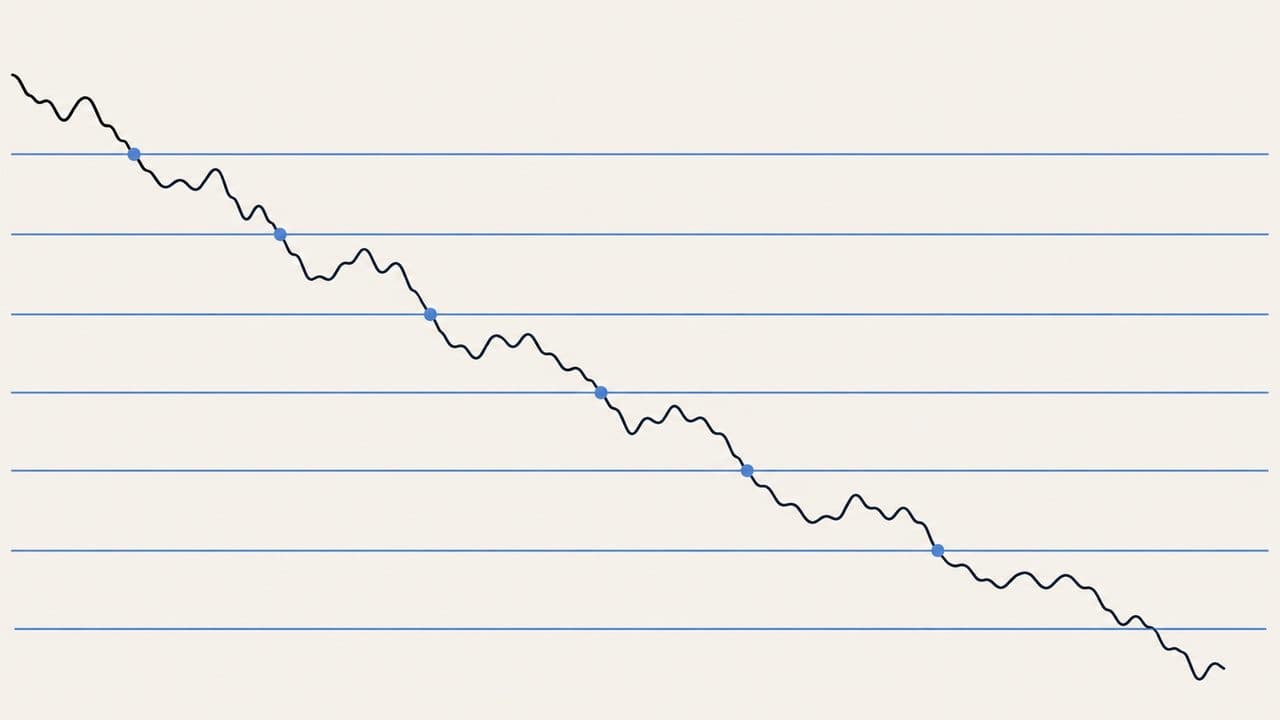
Grid systems place orders at fixed price intervals around a reference, while martingale systems increase position size after an adverse outcome. They depend most on price remaining within a sufficiently wide range and on capital being available before a one-way move exhausts the grid or the size progression.
What it is
A grid divides a price area into levels. A fixed-size grid opens or closes units as price crosses those levels, often expecting repeated movement between them. A grid can be directional, neutral or paired with a trend filter. The defining feature is the spacing of orders rather than an assumption about a particular indicator.
Martingale is a position-sizing rule derived from a betting idea: after a loss, the next stake is increased so that a later win can recover earlier losses and add a fixed amount. In financial markets, the size may double or follow another multiplier. A grid and a martingale are not identical. A grid can use equal sizes, while a martingale can be applied without a grid. They are often combined because price levels provide repeated points at which size is increased.
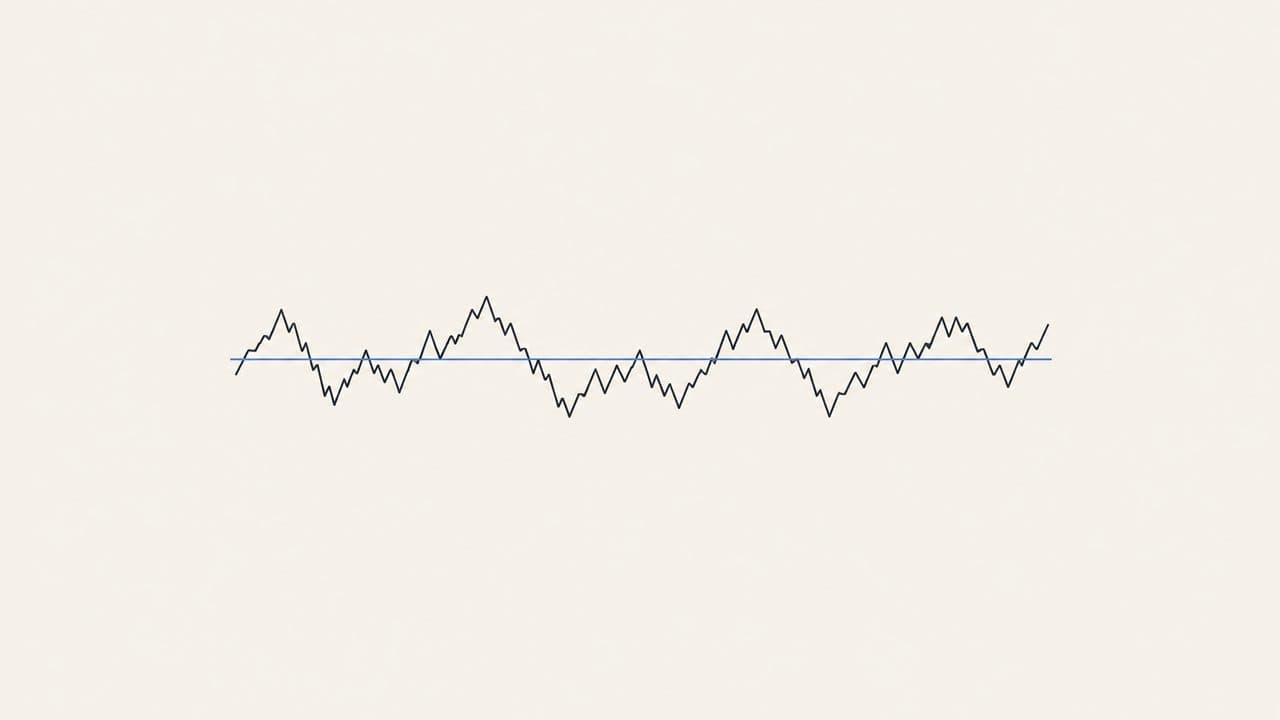
The system is applied to shares, foreign exchange, indices, commodities and other instruments where orders can be placed at chosen levels. Timeframes range from intraday to weeks. A market that oscillates can produce many closed grid trades, while a market that moves continuously in one direction can build a large inventory.
What it requires
The approach requires a defined reference, grid spacing, order size, maximum number of levels and rule for closing the inventory. It also requires a decision about whether the grid is reset after a cycle, how open positions are valued and whether orders remain active through news and market closures. Without those definitions, the visible results cannot be reproduced.
Capital is the central requirement. Each filled level consumes cash or collateral, and a martingale progression consumes it at an increasing rate. A position can become larger while the market is moving against it. The account must also absorb financing, spread, commission and slippage on every fill. A finite account cannot continue a doubling sequence indefinitely.
The instrument must have sufficient liquidity at all grid levels, but liquidity can disappear during a gap or event. Monitoring is required for a stuck order, a platform interruption, a change in contract terms and a market that moves outside the original grid. Historical data must include the path through the levels, not only the opening and closing prices.
How it is implemented
An implementation sets a central reference and a spacing, such as one price unit between levels. It then sets the number of levels above and below the reference, the size at each level and the conditions for closing or resetting the system. A fixed grid assigns equal size to each level. A martingale grid multiplies the size after each adverse fill, for example 1, 2, 4 and 8 units.
The system also needs a maximum inventory, drawdown limit or closure condition. A cycle can close when price exceeds the weighted average, but that does not remove open loss while price continues away from the grid. Resetting after a loss can hide accumulated loss unless every cycle is recorded together.
Worked example
First consider one small grid cycle. A one-unit position is opened at a mid-price of 99 and closed at 100. Gross result is 100 − 99 = 1.00. Assume a round-trip spread cost of 0.10 and commission of 0.20 on entry plus 0.20 on exit. Total cost is 0.10 + 0.20 + 0.20 = 0.50. Net result is 1.00 − 0.50 = 0.50 price units.
Now consider a martingale grid as price falls through four levels. Buy 1 unit at 100, 2 units at 99, 4 units at 98 and 8 units at 97. Total inventory is 1 + 2 + 4 + 8 = 15 units. The total entry value is (1 × 100) + (2 × 99) + (4 × 98) + (8 × 97) = 100 + 198 + 392 + 776 = 1,466. The average entry price is 1,466 ÷ 15 = 97.7333.
If all 15 units are closed at 95, the exit value is 15 × 95 = 1,425. Gross drawdown is 1,425 − 1,466 = −41. Assume round-trip dealing cost of 0.30 per unit. Cost is 15 × 0.30 = 4.50. Net result is −41 − 4.50 = −45.50 price units. The small closed gain does not offset the inventory loss. If capital prevents the next required order, the intended recovery sequence stops before the calculation is complete.
Costs
Every grid fill pays spread and usually commission. A dense grid can generate high turnover even when the net price range is small. Financing accumulates on open inventory and can differ by direction. Slippage can occur when several levels are crossed in one move or when an order is filled after a gap.
Martingale sizing magnifies dealing costs because the number of units increases after adverse movement. A system that reports each closed grid cycle without reporting floating loss, financing and all previous cycles can make the cost side appear smaller than it is. A historical test must include order priority, partial fills, gaps and the cost of closing the full inventory.
Where it fails
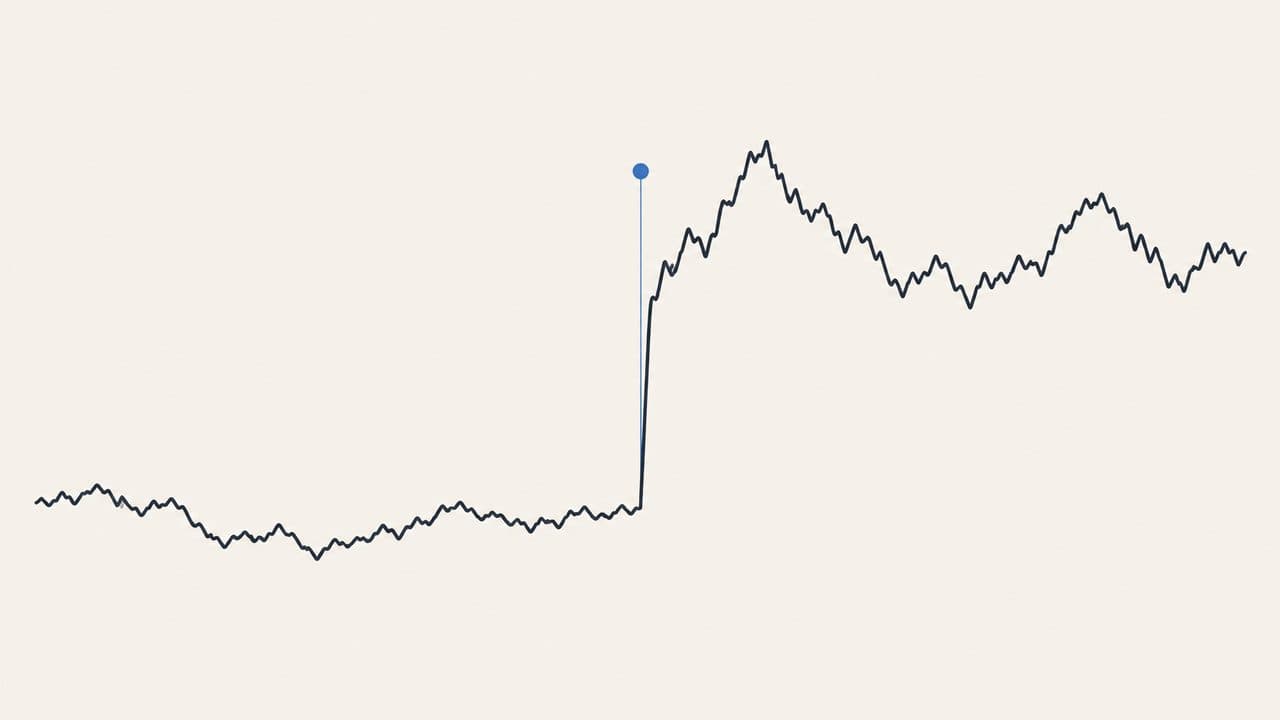
Grid and martingale systems are hurt by a sustained one-way move, a gap through several levels, a volatility expansion or a market closure. The grid accumulates exposure in the direction of the loss. The martingale multiplier then increases the inventory precisely as the distance from the original reference grows. A finite account eventually reaches a capital, margin or maximum-order limit; a forced closure can consume all capital allocated to the system.
The system can also fail in a range if the spacing is too narrow for costs or if the market repeatedly crosses levels without enough movement to cover dealing charges. Behavioural errors include widening the grid after the move begins, removing the maximum-inventory rule, resetting the system without recording the loss, and assuming that a long sequence of small closed gains changes the arithmetic of the next one-way move.
Who it suits and who it does not
A fixed grid can be analysed by someone who understands inventory, range risk and the full accounting of open and closed positions. Even then, the system requires sufficient capital for its stated maximum inventory and a process for stopping when the market leaves the intended range.
Martingale sizing is less compatible with any account that cannot fund the full size progression or tolerate a large, concentrated drawdown. Both approaches are unsuitable when the reader cannot monitor gaps, financing and open inventory. A regular history of small closed gains does not demonstrate that the system can withstand an unbounded or long one-way move.
What the evidence says
There is no widely accepted peer-reviewed study that validates the common retail grid or martingale templates as a general market method. Sullivan, Timmermann and White (1999) showed how selecting rules from a large set can exaggerate historical evidence, which is relevant when a grid spacing or multiplier is chosen after inspecting results. Park and Irwin (2007) reviewed technical-rule research and found that conclusions depend on data, testing methods and costs; their review does not test the grid arithmetic directly.
Barber and Odean (2000) studied active individual trading and found that turnover and decision frequency were associated with lower net outcomes in their household sample. That is not a direct test of a grid or martingale, but it is relevant to the cost accumulation created by repeated position changes. The direct evidence for the combined retail system remains limited; its drawdown arithmetic follows from the position sizes and prices rather than from a claim about historical prediction.
Sources
- Sullivan, Timmermann and White (1999), “Data-Snooping, Technical Trading Rule Performance, and the Bootstrap”, DOI.
- Park and Irwin (2007), “What Do We Know About the Profitability of Technical Analysis?”, DOI.
- Barber and Odean (2000), “Trading Is Hazardous to Your Wealth: The Common Stock Investment Performance of Individual Investors”, DOI.
- John J. Murphy, Technical Analysis of the Financial Markets (1999), Google Books.
Educational only: Grid and martingale systems can turn repeated small closed gains into a large inventory loss during a sustained one-way move.
Written by the Ultimo Research Desk and checked against our own contract specifications and client agreement before publication; reviewed again when those change. Educational only — nothing here is a recommendation to trade. Spotted an error? Tell us.