6 minute read · Ultimo Research Desk · Reviewed 5 Sept 2026
Swing Trading: What It Is, What It Requires and Where It Fails
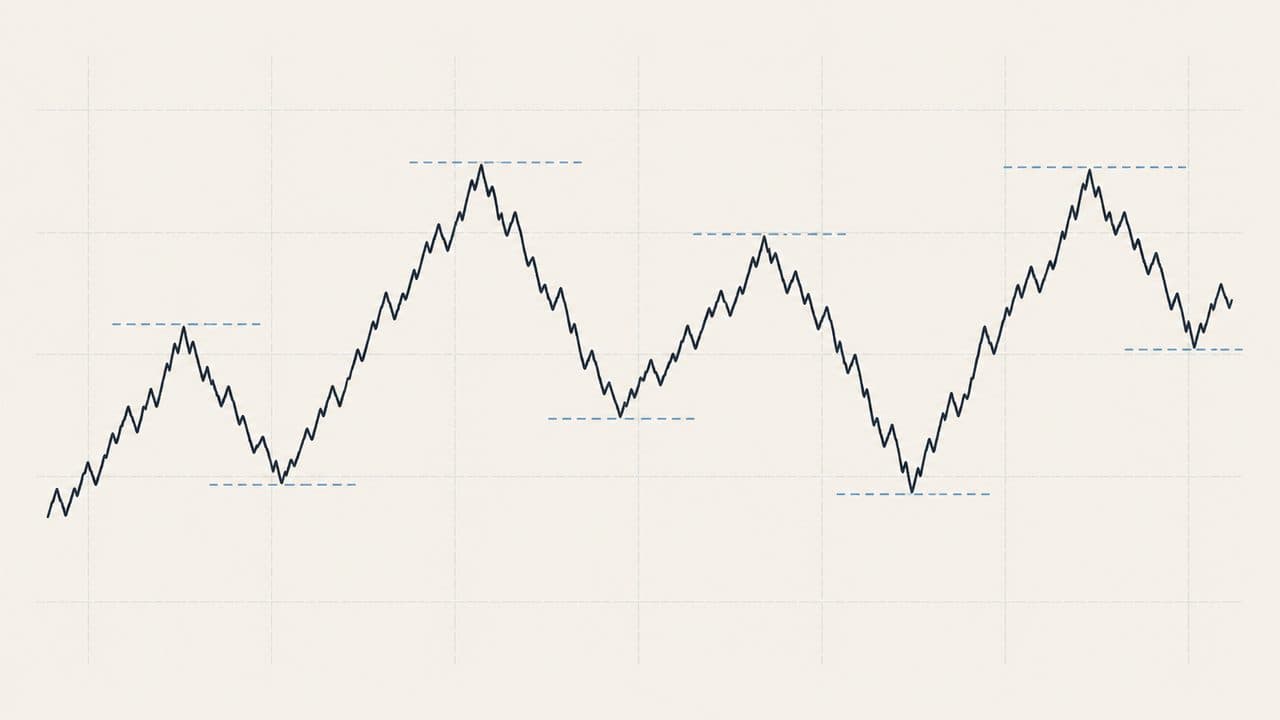
Swing trading holds a position for an intermediate price movement, usually from several days to several weeks, rather than for a single session or a long investment horizon. It depends most on the chosen swing lasting long enough to cover overnight risk, dealing costs and the delay between identifying a move and closing it.
What it is
The term describes a holding period and a style of analysing price movement rather than one standard formula. A swing trader may study successive highs and lows, support and resistance, moving averages, volatility, momentum or company and economic information. The position is intended to capture part of an intermediate move. It may be long or short, directional or relative between two instruments.
Swing trading is applied to shares, indices, foreign exchange, commodities, interest-rate instruments and other markets with regular price data. The relevant chart may be hourly, four-hourly or daily, while a weekly chart can provide broader context. The approach has no single documented inventor. Its methods overlap with older chart analysis, momentum research and short-horizon mean-reversion research, but “swing trading” is not a defined academic asset class.
The holding period creates a different risk profile from day trading. Positions can remain open during market closures, economic announcements and changes in liquidity. It also creates a different requirement from long-term investing because the reference levels and expected movement are updated more frequently. A swing trade is not defined by one indicator or by a fixed number of days.
What it requires
Swing trading requires scheduled review rather than continuous observation in every implementation. The review interval must match the chart interval. A method using daily closes can be checked once per day, while an hourly method needs more frequent attention. The trader also needs a calendar for market closures, scheduled economic releases and company events relevant to the instruments being monitored.
Capital must accommodate overnight gaps and positions that move against the intended swing before the exit condition is reached. Position size is normally related to the distance between entry and the chosen invalidation level, not simply to the price of the instrument; the position size calculator performs that arithmetic. Diversification can reduce concentration, but similar instruments may react to the same interest-rate, currency or risk event.
The data must be consistent across the chosen timeframe. Adjusted prices, contract rolls and differing sessions can change a visible swing. Execution quality matters after a gap or outside the most liquid period. Records of entries, exits, costs and holding time are needed for a complete assessment.
How it is implemented
An implementation defines what counts as a swing high or low, what confirms a move and what ends the position. A reference may be a recent range, a moving-average relationship, a measured retracement or a fundamental event. The position can be opened after a condition is observed, reduced as the move develops and closed at a stated level, time limit or change in the underlying assumption.
Position sizing may use fixed units, a fraction of capital or an estimate of the amount at risk to the invalidation level. A model may also limit the number of simultaneous positions or the exposure to one sector or currency. The mechanics must include how a gap is handled, whether an unfilled order expires and how financing is counted. These details often matter more than the label “swing”.
Worked example
Assume one unit enters at a mid-price of 100 after a swing condition is observed. The assumed round-trip spread cost is 0.20. Commission is 0.20 on entry and 0.20 on exit. Financing is 0.05 per day for two days, or 2 × 0.05 = 0.10. Total cost is 0.20 + 0.20 + 0.20 + 0.10 = 0.70.
In a favourable case, the exit mid-price is 104. Gross result is 104 − 100 = 4.00. Net result is 4.00 − 0.70 = 3.30 price units.
In an adverse case, the exit mid-price is 98. Gross result is 98 − 100 = −2.00. Net result is −2.00 − 0.70 = −2.70 price units. If the instrument gaps from 100 to 97 before the exit is processed, the actual result can be lower than the planned 98 case. The numbers are illustrative and show both directions of the same holding-period method.
Costs
Spread and commission are paid whenever the position is opened, reduced or closed. A swing approach may have fewer transactions than an intraday approach, but the position is exposed for longer. Financing can accumulate over several days or weeks. A short position can have different funding and availability conditions from a long position.
Slippage is particularly relevant at overnight gaps, market openings and scheduled announcements. A stop or limit level may fill at a different price. Data subscriptions, market access and currency conversion may also matter. A historical test must use the same session, adjustment and timing conventions as the intended implementation.
Where it fails
Swing trading is hurt by a market that moves sideways without completing the expected swing. Repeated changes between local highs and lows can create several small losses or produce a sequence of premature exits. It can also fail when a trend accelerates and leaves the planned level behind, or when a gap invalidates the original reason for the position.
Using too many indicators can make the definition of a swing unstable. Changing the reference after a position is open can turn a defined method into an unrecorded discretionary decision. Behavioural errors include holding beyond the stated time limit, adding after an adverse gap, reducing a position only after a loss has become large, or treating one successful swing as evidence about the next market regime.
Who it suits and who it does not
Swing trading is more compatible with someone who can review instruments on a regular schedule, accept overnight and weekend exposure, and record decisions over a sufficiently long sample. It requires capital for gaps, financing and positions that may remain open for days.
It is less compatible with someone who cannot monitor scheduled events, needs all positions closed each session, or cannot tolerate a position being held while the expected move develops slowly. It is also less suitable when the available data or liquidity does not support reliable swing definitions.
What the evidence says
There is no single peer-reviewed definition of swing trading, so studies of related effects should not be treated as direct tests of the approach. Jegadeesh and Titman (1993) examined medium-term cross-sectional momentum, which overlaps with some swing methods but uses portfolio ranking rather than an individual chart swing. Poterba and Summers (1988) examined longer-horizon mean reversion, which can be the opposite of a continuation-based swing method.
Park and Irwin (2007) reviewed technical-analysis research and described evidence that varies with market, period, testing method and costs. Sullivan, Timmermann and White (1999) showed the importance of correcting for data selection when many rules are tested. The evidence does not identify a universal swing-trading rule; it supports separating the holding-period label from the specific signal and risk process being tested.
Sources
- Jegadeesh and Titman (1993), “Returns to Buying Winners and Selling Losers: Implications for Stock Market Efficiency”, DOI.
- Poterba and Summers (1988), “Mean Reversion in Stock Prices: Evidence and Implications”, DOI.
- Sullivan, Timmermann and White (1999), “Data-Snooping, Technical Trading Rule Performance, and the Bootstrap”, DOI.
- Park and Irwin (2007), “What Do We Know About the Profitability of Technical Analysis?”, DOI.
- John J. Murphy, Technical Analysis of the Financial Markets (1999), Google Books.
Educational only: Swing trading remains exposed to overnight gaps, financing and changes in the price pattern during the holding period.
Written by the Ultimo Research Desk and checked against our own contract specifications and client agreement before publication; reviewed again when those change. Educational only — nothing here is a recommendation to trade. Spotted an error? Tell us.