8 minute read · Ultimo Research Desk · Reviewed 5 Sept 2026
Prop Firm Challenge Rules, Read Properly
Most challenge accounts are not lost by being wrong about the market. They are lost by breaking a rule while being roughly right about it — a daily limit touched on an otherwise profitable week, a position held twenty minutes into a data release, a lot size that broke a consistency clause nobody had read. The rules are not fine print around the product. They are the product, and each one exists for a reason that can be stated plainly.
What the rules are for
A firm selling evaluations is exposed to two things: traders who are genuinely good, and traders who are lucky. Both look identical over a short window. Every rule below is an attempt to separate them cheaply, and to cap what a lucky one can cost before the distinction becomes clear.
Reading them that way makes each rule predictable. The question to ask of any clause is not "is this fair" but "which of those two problems is it solving" — and the answer usually tells you exactly how it will be enforced at the edge.
The daily loss limit
Typically 4 to 5 per cent of the account, measured from a starting point that resets each day. Breach it and the account ends, regardless of the balance.
Two details decide whether it catches you. The first is what the day is measured from: the balance at the daily reset, or the highest equity reached during the day. Measured from the high, a good morning tightens the limit for the afternoon — a trader up 3 per cent by lunch may have only 1 to 2 per cent of room left, at exactly the moment they feel most confident.
The second is whether it uses balance or equity. An equity-based limit counts open positions, so an unrealised loss at the wrong second breaches it even if the position later recovers. A trader holding a losing position through an expected bounce is, under an equity limit, holding it through the breach.
This is the rule that ends most accounts, and it ends them on days when the trader is ahead for the week.
The maximum drawdown
Usually 8 to 12 per cent, and the distinction that matters is static against trailing.
A static drawdown is measured from the starting balance. On a $100,000 account with a 10 per cent limit, the floor is $90,000 and stays there.
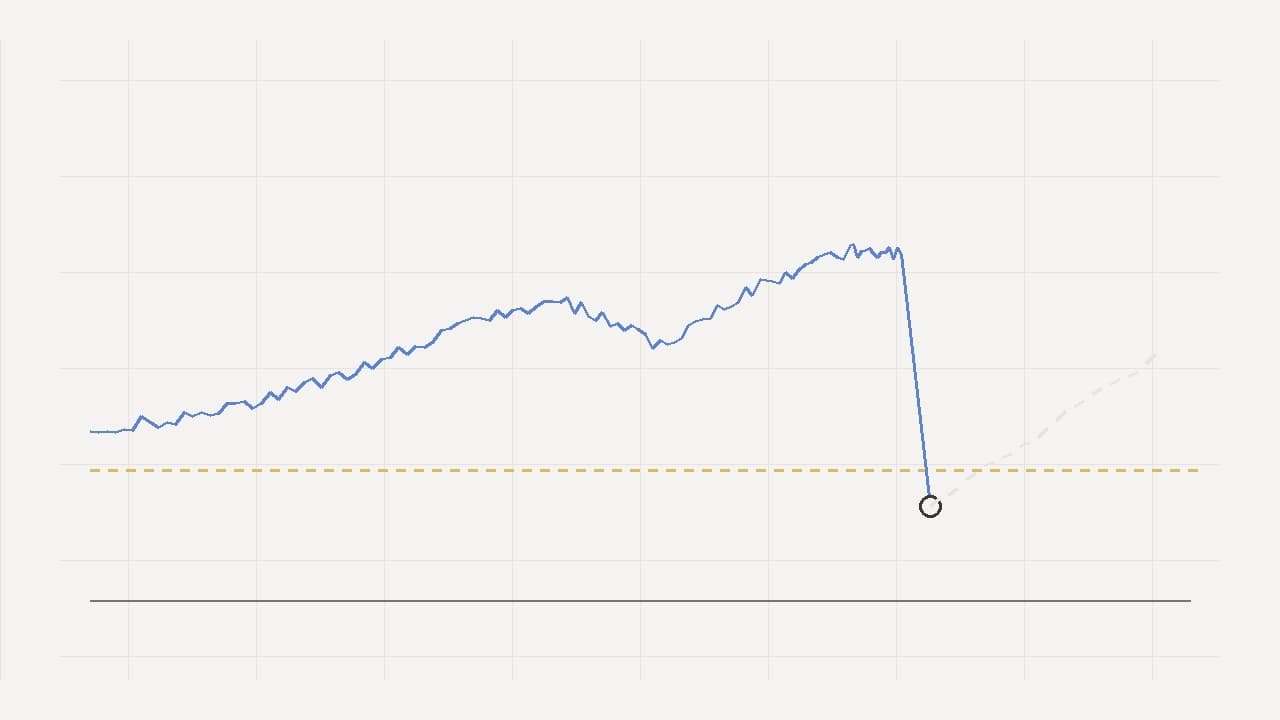
A trailing drawdown follows the account's highest point. The same account reaching $107,000 has its floor move to $97,000 — so the trader can now lose $10,000 from the high but only has $7,000 of actual profit. A run to $107,000 and back to $96,500 breaches a rule while the account is still $3,500 ahead of where it started.
Some trailing drawdowns stop moving once the account is up by the drawdown amount. Some never stop. Whether they lock is one of the most consequential lines in any agreement and is rarely emphasised in the marketing.
The profit target
Commonly 8 to 10 per cent in the first phase and about half that in the second, sometimes with a time limit and sometimes without.
Read it next to the drawdown, because together they set the risk you are permitted. An 8 per cent target against a 5 per cent daily limit and a 10 per cent maximum means the account must make eight while never losing five in a day or ten in total. Sized to hit the target quickly, the drawdown is reached first; sized to respect the drawdown, the target may take longer than the time limit allows. The pair, not either alone, is the constraint — and where they are set close together, the arrangement rewards variance rather than skill.
Minimum trading days
Usually three to ten days on which at least one position must be opened. It exists to stop a single fortunate trade passing an evaluation, which is a reasonable thing to want.
Its side effect is that it forces trading on days when there is nothing to do. A trader who reaches the target on day two must keep placing positions to satisfy the count, and positions placed to satisfy a count are not positions taken for a reason. A meaningful share of failures happen after the target has already been met.
The consistency rule
The clause most often discovered after the fact. In its common form, no single day — or sometimes no single trade — may account for more than a set share of total profit, often 20 to 50 per cent.
It targets the trader whose whole result came from one position. The difficulty is that it is frequently assessed at payout rather than enforced during the challenge, so a trader can pass, trade, request a payout and only then be told the distribution of their profit does not qualify. It also penalises legitimate approaches: news-event trading and breakout approaches concentrate their returns by design.
Where a consistency rule exists, it should be read before the profit target, because it constrains how the target may be reached.
News and weekend restrictions
Some agreements forbid holding positions through high-impact releases, typically a window of a few minutes either side. Some forbid holding over the weekend. Some forbid both.
They exist because a gap can move a position further than any stop-loss order can protect against — which is true, and is a real risk on a live account too. The practical effect is to rule out entire approaches. A trader whose method depends on the economic calendar or on multi-day swing positions should establish this before paying, not after.
What to establish before paying
Every one of these has a version that suits some traders and a version that suits almost nobody. The agreement, not the landing page, is where they are defined. Six questions settle most of it:
Is the daily limit measured from the daily start or the intraday high, and does it use balance or equity. Is the maximum drawdown static or trailing, and if trailing, does it lock. Is there a consistency rule, and is it enforced during the challenge or at payout. Are news and weekend positions restricted. What is the time limit, if any. And what are the payout conditions in full — frequency, minimum, method, and the circumstances in which a payout can be refused.
If a firm will not show the full terms before purchase, that is itself the answer.
The part the rules do not cover
None of this makes an account profitable. The rules describe how an account can end; they say nothing about how one is made to work. A trader who cannot produce a positive expectancy after costs will fail a challenge slowly instead of losing a live account slowly, and will pay a fee for the privilege.
The arithmetic of the attempt — how many people pass, how many are ever paid, and what that implies about the expected cost of trying — is in what the pass rates actually say.
Written by the Ultimo Research Desk and checked against our own contract specifications and client agreement before publication; reviewed again when those change. Educational only — nothing here is a recommendation to trade. Spotted an error? Tell us.